
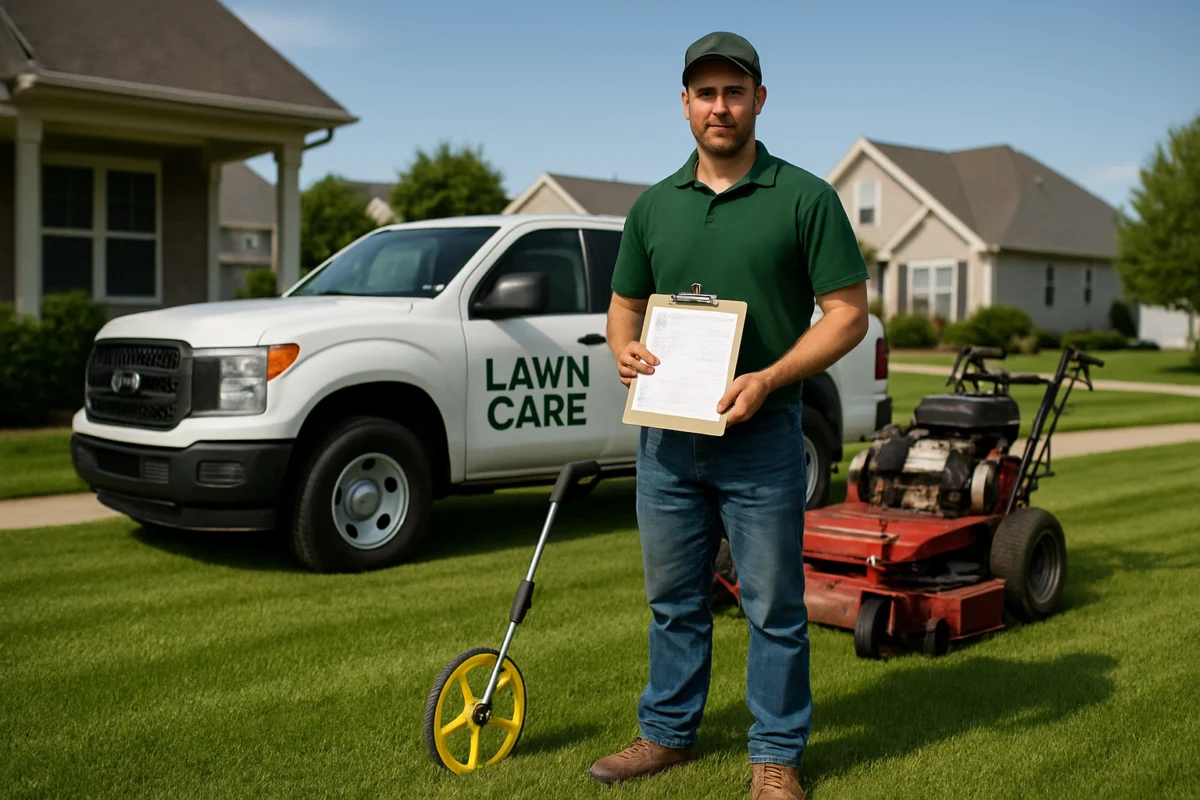
Pricing lawn care jobs is where most new operators win or lose. Charge too little and you burn out. Charge too much and you scare away customers. This guide walks you through practical, no-BS steps to estimate, price, and present lawn care quotes that protect profit and close more jobs.
Who this is for and how to use it
This is for solo operators and small crews bringing in $0 to $1M a year. If you cut grass, trim edges, do weekly maintenance, or offer one-off cleanups, these pricing tactics work. Read straight through for a complete system, or jump to the sections you need: quick estimate method, packaging, quote scripts, or scaling pricing when you hire crews.
Why proper pricing matters
Good pricing does three things. It covers your labor and costs, leaves room for profit, and sets customer expectations. Bad pricing hides inefficiencies. It forces you to work more hours to make the same money, and it makes growth impossible.
Price like a technician and you stay busy. Price like a business owner and you build an asset.
Pricing models: flat rate, per visit, and hourly
There are three common ways lawn care companies charge. Each has pros and cons.
Hourly pricing
Charge for hours worked. Simple to explain. Works for one-off jobs or unknown scopes. Major downsides are customer pushback and incentive problems. If you are slow, you lose money. Customers often fear hourly bids because they lack predictability.
Per visit pricing
Charge a fixed price per visit based on lawn size and service list. This is the most common for recurring maintenance. Easy for customers to budget. It rewards efficiency. If you get faster, your margin grows.
Flat rate project pricing
Best for cleanups, mulching, aeration, or install jobs. You estimate the entire job and set one price. Customers like clarity. You must get the scope right. Underestimate and you absorb the extra work.
Core pricing formula every operator should use
Start with this simple math before you quote anything.
- Labor cost per hour = desired technician pay plus payroll taxes and benefits divided by billable hours.
- Overhead allocation = monthly fixed costs divided by expected monthly revenue.
- Materials and disposables = direct costs for the job.
- Profit margin = add 15 to 40 percent depending on competition, risk, and value.
Quoted price = (Labor cost + Overhead allocation + Materials) x (1 + Profit margin).
How to calculate labor cost per hour
Too many owners use their take-home pay to set rates. That hides real costs. Do this instead.
- Decide target hourly technician pay. Example: $20 per hour.
- Add payroll taxes and benefits. Use 20 to 30 percent as a rule of thumb. Example: $20 x 1.25 = $25.
- Estimate billable hours per week per tech. Include travel and small tasks. A realistic number for lawn crews is 30 to 35 billable hours per week.
- Convert to monthly or annual to match overhead. This gives true labor cost per hour.
Example
Target pay $20. Taxes/benefits factor 1.25. Labor cost = $25/hour. If a tech averages 32 billable hours a week, that is your baseline for job estimates.
Estimate job time accurately
Estimating time is the single biggest skill for profitable pricing. Use these methods to get faster and more accurate.
Measure the lawn
Use Google Maps or a measuring wheel to get square footage. Break the property into sections. Note slopes, obstacles, gates, and long walks to reach the mower. Those change time dramatically.
Track real times
For the first months, track every job. Note the start and finish and what slowed you down. A simple spreadsheet or any field service app can do this. After 50 to 100 jobs, you will see consistent averages by lawn size and conditions.
Think in task minutes
Break the job into tasks and assign minutes. Mowing, trimming, edging, blowing, hauling clippings. Add setup and travel time. It is easier to estimate small tasks than the whole job in one go.
Pricing rules of thumb
Use these starter numbers until you collect your own data. Adjust for your market and costs.
- Small yards (up to 5,000 sq ft): $35 to $50 per visit for basic mowing and trimming.
- Medium yards (5,000 to 12,000 sq ft): $50 to $90 per visit.
- Large yards (12,000 to 20,000 sq ft): $90 to $150 per visit.
- Weekly service keeps you in the lower end of these ranges. Biweekly or one-time jobs should be 20 to 40 percent higher.
These are national ranges. Adjust for your local market, competition, and added services like edging, bagging, or fertilizing.
How to build pricing packages that sell
Most customers do not want to think about minutes. Give them choices. Packages simplify selling and increase average ticket.
Three-tier package model
Offer three clear packages: Basic, Standard, and Premium. Make each step up a clear value add.
- Basic: mowing, string trimming, blow off. Lowest price. For customers who want no extras.
- Standard: Basic plus edging and bagging of clippings. Mid price. Most customers choose this.
- Premium: Standard plus weekly check, weed control, and seasonal cleanups. Highest price and best margin.
Add-ons and upsells
Charge separately for services that take extra time or equipment. Examples: dethatching, aeration, mulching, hedges, tree trimming, and bed maintenance. This keeps the recurring price predictable while letting you increase ticket size when needed.
Quick quote cheat sheet for door-to-door or phone leads
When a lead calls, you need to quote fast. Use this shortcut until you can do a site visit.
- Ask lawn size: small, medium, large, or estimate square feet.
- Ask service frequency: weekly, biweekly, one-time.
- Ask about slopes, steepness, gates, or long walks.
- Offer a range and a site visit price. Example: “For weekly service, lawns this size usually run $60 to $80 per visit. I can do a quick visit for $25 that will give you an exact price and I will apply the $25 to your first service.”
This lowers friction and filters time-wasters. The small site visit fee weeds out tire-kickers and covers your travel cost.
Sample job estimate with math
Real example for a medium yard, 8,000 sq ft, weekly mowing, trimming, edging, and blowing.
- Labor estimate: 1.5 hours for mowing, 30 minutes trimming/edging, 15 minutes blowing = 2.25 hours.
- Labor cost: $25 per hour x 2.25 = $56.25.
- Materials/disposables: $2 per visit (gas, string, bags). Add small equipment wear allowance per job: $3.
- Overhead allocation: If monthly overhead equals $2,000 and expected monthly revenue $8,000, overhead rate is 25 percent. Apply 25 percent to the subtotal.
Subtotal before profit = $56.25 + $5 = $61.25. Apply 25 percent overhead = $76.56. Add profit margin 25 percent = $95.70. Round to $96 or $99 per visit depending on your price strategy.
Handling competition and lowballers
Price is rarely the only factor. If a competitor undercuts you, ask what they include. Many lowballers skip edging, blow off, or use bait pricing. Explain your value and be specific about what you do differently.
When you must compete on price, reduce scope not margin. Offer a stripped back “cut-only” service at a lower price, but keep your return customers on packaged services.
Common beginner pricing mistakes and how to avoid them
- Underestimating travel time. Track drive times for each neighborhood. Group customers by route to reduce travel cost.
- Not charging for gates, stairs, or long walks. Add surcharges for extra time or complex properties.
- Using personal wage as business profit. Separate owner pay and business profit in your numbers.
- Not updating prices. Inflation and fuel both increase costs. Review pricing at least twice a year.
- Giving huge discounts early. If you need to discount to close, offer a time-limited trial or a one-time discount applied to the second month only.
What to put on a professional quote
A neat, clear quote converts. Include these elements.
- Business name, logo, and contact info.
- Scope of work with bullet points. Be precise about what is and is not included.
- Price per visit and billing frequency. State start date and any minimum term for recurring work.
- Extras and surcharges. Call them out clearly.
- Payment terms and accepted methods. Late fee policy if you use one.
- Signature line or button for approval. Make it easy for the customer to say yes.
Phone and email script to close a quote
Keep it short. Use this script as a template.
Hi, this is Sam from Greenway Lawn Care. I have your quote ready. For weekly service at [address], the price is $99 per visit, including mowing, edging, trimming, and blow off. We can start next Tuesday. If that works I will get you set up and send the confirmation now. Any questions?
Always ask for a start date. People who set a start date tend to commit. If they hesitate, give a small incentive like a discounted first month or free edging on the second visit.
Tools and software to make pricing easier
At the beginning, a spreadsheet is fine. But you will outgrow it fast. Field service software saves time on estimates, routing, invoicing, and follow up.
Jobber and Housecall Pro are popular with small lawn care companies. Jobber has simple quoting and invoicing with route planning. Housecall Pro is user friendly and strong on payments. Workiz is good for dispatching, and ServiceTitan is a heavier, more expensive option aimed at larger companies. Test two systems and pick the one that fits your budget and workflow.
How to raise prices without losing customers
Communicate price increases clearly and give reasons. A common approach is to grandfather current customers for a defined period and apply new pricing to new customers. Alternatively, add value and raise price at renewal. People accept increases when you explain rising costs, improved service, or added value like better communication or online payments.
Scaling pricing when you add crews
When you hire, your costs change. Standardize job times and use performance targets. Pay crews hourly with performance bonuses rather than flat share models until you have a reliable productivity baseline. This keeps your margins predictable and avoids exploding payroll costs.
When to offer discounts and when to say no
Use discounts as strategic tools, not as default negotiation moves. Offer discounts for longer commitments, like three month agreements, or prepayment. Do not discount simply because a lead asks for a cheaper price. If a prospect pushes too hard, walk away. Cheap customers are often expensive to service.
Tracking profitability by job
Every job should have a margin. Track actual labor hours and costs for each job and compare to your quoted estimate. This tells you where you are losing money. Adjust pricing or processes when you see consistent overrun on a job type.
Simple tracking method
- Log start and finish time for each visit.
- Record materials used and any issues encountered.
- Compare the logged cost to the quoted price monthly.
- Adjust estimates and price lists based on the data.
Real talk: pricing is a skill
You will make mistakes. Expect it. The difference between surviving and thriving is how fast you learn. Start with conservative margins, track everything, and adjust. Over time you will build pricing templates for every common property size and service that save you hours of estimating and protect profit.
If you are juggling missed calls, no follow-up system, five different apps, and paper estimates, you know the pain. Autopilot ties those pieces together. It handles scheduling, dispatching, invoicing, calls, texting, and basic marketing in one place. Replace the patchwork and use the data from one system to refine prices, track real job times, and follow up with leads. No hard sell, just fewer headaches and more booked jobs when you need them.