
Selected Industry: Gutter cleaning
Selected Content Type: Troubleshooting and Operations
Selected Keyword Angle: handling frozen gutter ice-dam emergency cleanouts for Minneapolis property managers during winter thaw same-day jobs
Selected Audience Stage: Scaling
Meta Description: Operations playbook for scaling same-day frozen gutter ice-dam cleanouts for Minneapolis property managers, with pricing, staffing, and safety protocols.
Winter in Minneapolis creates a predictable headache for property managers. When temperatures dip and heavy snow meets inconsistent thaw cycles, ice dams form in gutters and along eaves, causing leaks, fascia damage, and unhappy tenants. For gutter cleaning companies aiming to scale, offering reliable same-day emergency ice-dam cleanouts for property managers is a high-ticket, repeatable service that can grow revenue and secure long-term contracts. This playbook walks through practical operations, safety protocols, pricing templates, staffing, marketing tips, and systems you need to scale without blowing up your margins or your crew.
Why emergency ice-dam cleanouts are a high-value niche
Ice dams create urgent problems. A single leak can damage interiors, force temporary relocations, and trigger insurance claims. Property managers need fast, competent responses to prevent costly repairs. That urgency translates to higher pay-per-job and recurring demand in cold climates. If you structure operations for speed and safety, you win market share and higher lifetime value clients.
Characteristics that make this niche profitable
- High urgency equals premium pricing. Property managers pay to avoid tenant disruptions.
- Repeat business. Late fall to early spring offers multiple calls per season from the same buildings.
- Referral potential. Successful emergency responses lead to preferred vendor status.
- Barrier to entry. Proper safety training and equipment keep casual competitors out.
Essential safety and liability checklist
Working on icy roofs and ladders carries real risk. Before you advertise same-day emergency jobs, lock down safety protocols and paperwork.
Insurance and contracts
- General liability that covers roof work. Verify coverage limits and policy language.
- Workers compensation for all crew members.
- Service agreement for property managers that spells out scope, exclusion of pre-existing roof damage, and emergency access terms.
- Hold-harmless clauses for tenant-side belongings when interior leaks are possible, with clear reporting requirements.
On-the-job safety practices
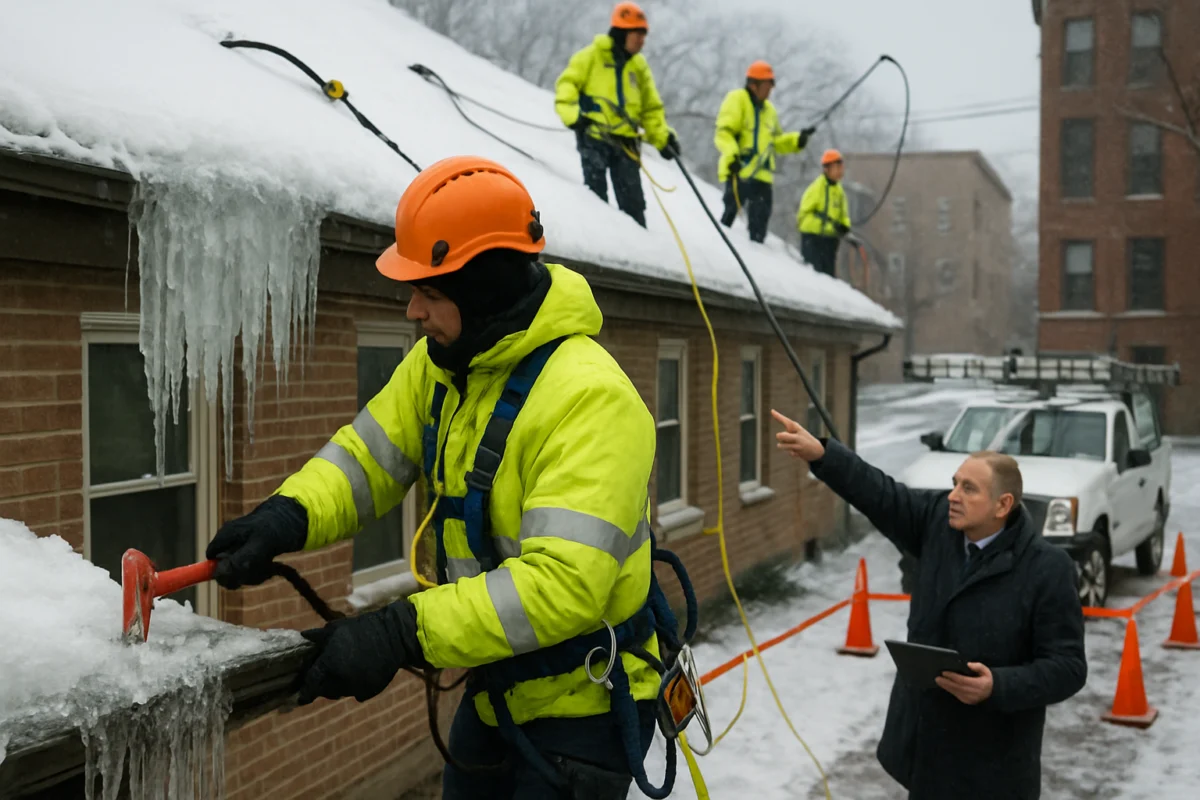
- Mandatory fall protection when working above specified heights. Use tie-off anchor points and harnesses.
- Proper ladder setup, with roof standoff brackets where needed.
- Heated boots, insulated gloves, and helmets with full-face protection for falling ice chips.
- Ice chipping tools that minimize roof shingle damage. Avoid metal scrapers on old shingles.
- Clear communication and spotters when working near walkways or parked cars.
Tools, materials, and vehicle setup for same-day ice-dam response
Speed matters. Your truck should be a mobile ice-dam mitigation station with everything organized for quick loading and unloading.
Recommended toolkit
- Heat cables and gel-based de-icer for targeted thawing.
- Telescoping roof rakes to remove snow before chipping ice dams.
- Warm water steamers or low-pressure steamers when safe for shingles, used by trained techs.
- Plastic shovels, rubber mallets, and non-abrasive ice chisels designed for roofing work.
- Roof anchors, harnesses, and rope systems for fall protection.
- Tarps and drip pans to protect landscaping and building exteriors.
- Portable generators and extension cords for pumps or heaters.
Vehicle organization tips
- Use labeled bins and vertical racks for rakes and ladders to save time.
- Keep a rapid-deploy safety kit with cones, signage, and salt to clear walkways.
- Stock a variety of heat cables and de-icing solutions sized for common roof lengths.
Staffing and training to scale same-day responses
Scaling emergency services requires predictable crew performance and a training pipeline so new hires hit the ground running.
Staff structure
- Core response team. Two to three technicians per vehicle during peak season for safety and speed.
- On-call supervisors. Experienced tech who can make judgment calls and approve extra equipment or pricing on-site.
- Dispatch coordinator. A dedicated person to manage incoming calls, sequencing, and client notifications during storms.
Training modules
- Ice-dam diagnosis. Teach techs to distinguish between rooftop ice, clogged gutters, and vent or insulation problems causing recurring dams.
- Repair vs stopgap. How to decide when a temporary thaw and gutter clearing will suffice versus recommending full roof or gutter replacement.
- Damage-minimizing techniques. Practical demos to avoid shingle damage while chiseling ice.
- Customer communication. Scripts for property managers to set expectations, document conditions, and log approvals for extra work.
Service offerings and pricing framework
Package your offerings so property managers can quickly choose the right response level. Transparent options reduce decision friction on emergency calls.
Example service tiers
- Rapid Thaw and Clear. Same-day visit to remove snow and open gutter channels, includes tarping and interior drip checks. Best for minor ice dams. Flat fee base plus per-foot charge.
- Ice-Dam Deconstruction. Aggressive removal of heavy ice dams using steam or safe mechanical methods, full post-inspection, and recommended follow-up work. Premium pricing, includes supervisor on-site.
- Preventive Install. Heat cable installation and seasonal maintenance, scheduled before heavy freeze cycles, contracted annually with volume discounts for property managers.
Pricing rules of thumb
- Charge a winter emergency dispatch fee. This compensates for same-day priority and mobilization.
- Use per-roof or per-linear-foot pricing plus safety complexity multipliers for tall buildings or hard-access roofs.
- Include minimums to cover fuel, labor, and wear on heated tools.
- Offer property-management contracts with retainer discounts to turn emergency calls into predictable revenue.
Operational playbook for handling incoming emergency calls
Quick triage, clear scope, and fast routing are what separate a chaotic operation from a scalable one. Here is an efficient workflow to implement.
Call intake and triage
- Obtain property manager contact, building address, and the affected unit numbers if relevant.
- Ask whether interior leaking is present, and if tenants are displaced. Prioritize safety calls first.
- Request recent photos if possible. A quick image can save an unnecessary dispatch or help size a job properly.
Dispatching rules
- Assign by proximity and crew capability. Keep the nearest trained crew on standby for high-priority clients.
- Use time blocks. Reserve a percentage of crews for immediate response during high-demand weather events, while others handle scheduled maintenance.
- Enable supervisor escalation. If a call looks complex, involve a senior tech before the crew leaves to confirm equipment needs.
On-site SOP
- Initial photo and damage log. Document pre-work conditions for liability and insurance documentation.
- Perform safe snow removal with rakes where possible, then target ice with non-damaging tools or controlled steam.
- Protect landscaping and walkways. Lay tarps and set up drip containment.
- Re-inspect gutters for structural issues. Note if full gutter replacement will be required later.
Sales scripts and proposals for property managers
Property managers expect clear pricing and fast paperwork. Keep proposals short and focused on outcomes.
Quick phone script
“Hi, this is Sam at North Star Gutter Co. We specialize in same-day ice-dam responses for multi-family properties in Minneapolis. Can you tell me if there is active leaking or tenant displacement? If not, we can usually clear gutters and relieve pressure within a single visit. Our emergency dispatch fee is X, with a base job of Y per roof. I can have a crew there in Z hours. Can I book that now?”
Sample one-page proposal elements
- Scope: Rapid Thaw and Clear or Ice-Dam Deconstruction
- Estimated price range and what triggers add-ons
- Timeline for same-day or next-available dispatch
- Liability items and pre-work documentation checklist
- Follow-up service options: heat cable install, full gutter replacement, seasonal maintenance contract
Marketing to property managers in Minneapolis
Positioning matters. The right message in the right channels converts property managers who need reliable winter partners.
Local SEO and keyword focus
- Target long-tail phrases. Examples: “Minneapolis ice dam removal for property managers,” “same-day ice dam cleanup Minneapolis multi-family.”
- Create a winter services landing page that explains emergency response protocols and includes local references, case studies, and a clear contact button.
- Use schema for local business and service area to improve local ranking.
Outreach and partnerships
- Cold email and LinkedIn outreach to property management firms. Keep messages short, with a one-line proof point and an offer for a free winter readiness audit.
- Offer preferred vendor agreements with guaranteed response windows during heavy-weather periods.
- Work with local insurance adjusters and roofers who may refer emergency work.
Managing cash flow and invoicing during high season
Emergency work can create spikes in revenue and in expenses. Keep your cash flow predictable with simple billing rules.
Billing best practices
- Collect emergency dispatch fees up front when possible, or require an authorization code from the property manager for urgent work.
- Invoice the same day with photos attached. Property managers appreciate immediate documentation for their internal records and for insurance claims.
- Set clear payment terms for property management clients. Offer ACH or card payment and apply small discounts for quick payments.
Equipment depreciation and replacement fund
Budget for accelerated wear on heat equipment and steamer maintenance. Set aside a percentage of emergency revenues into a replacement reserve to avoid sudden capital shortfalls.
Common troubleshooting scenarios and how to handle them
Recurring ice dams on the same building
- Diagnosis: likely insulation or ventilation issues causing heat loss. Recommend a thermal inspection and coordinate with trusted roofers or insulation contractors.
- Interim fix: install heat cables and offer seasonal maintenance plans to keep gutters clear until full repairs are scheduled.
Interior leaks after your work
- Document pre- and post-work photos and have the property manager sign an on-site form noting existing interior conditions.
- If the leak persists, escalate quickly and offer a coordinated inspection with roofing partners. Maintain open communication to preserve trust.
Shingle or fascia damage claims
- Always document roofing conditions before aggressive ice removal. If damage occurs, review photos to determine responsibility. Transparent documentation reduces disputes.
- Consider limited workmanship guarantees for specific methods and exclude liability for pre-existing roof weaknesses in your service agreement.
Tech stack recommendations for scaling operations
Tool overload is real, but the right set of tools will keep your team organized and responsive during storms.
Scheduling and dispatch
Look for software that supports real-time dispatch, route optimization, and mobile job notes. Jobber, Housecall Pro, Workiz, and ServiceTitan are known options. Each has strengths. Jobber is simple and cost effective for smaller teams. Housecall Pro and Workiz offer stronger dispatching features and integrations. ServiceTitan targets larger operations with deep reporting.
Communication and documentation
- Use mobile forms for photo capture and signature collection at the job site.
- Standardize SMS templates for status updates to property managers and tenants.
Payments and invoicing
Choose a system that lets you send invoices immediately, accept cards, and record paid dispatch fees. Integrations with accounting software reduce bookkeeping time.
Scaling tips to keep quality high
- Document every process into step-by-step SOPs and train new hires with shadowing shifts during low-risk calls.
- Batch similar jobs geographically to reduce travel time and increase same-day capacity.
- Keep a reserve crew for high-priority property managers. Reliability builds long-term contracts.
- Review every emergency job in a quick post-mortem to identify bottlenecks and safety near-misses.
Sample winter readiness checklist for property managers
- Pre-season roof and gutter inspection. Note any loose shingles or gutter detachment.
- Install heat cables in vulnerable sections before heavy freeze cycles.
- Schedule seasonal maintenance visits and reserve emergency response windows with your preferred vendor.
- Share tenant guidance about reporting leaks and avoid DIY roof work.
Handling same-day frozen gutter ice-dam cleanouts for Minneapolis property managers is a profitable niche if you build safety, speed, and systems into your operation. Start by locking down insurance and SOPs, equip your trucks for fast deployment, train crews on low-damage techniques, and set clear pricing with emergency dispatch fees. Market to property managers with targeted local SEO and preferred vendor agreements. Use a predictable dispatch and communications workflow to keep your response times short and your documentation tight. If you struggle with missed calls, poor follow-up, too many disconnected tools, or general disorganization, consider consolidating operations tools. Autopilot (www.autopilotapp.io) is an all-in-one platform for scheduling, dispatching, invoicing, calls, texting, and marketing that can help book more jobs and reduce tool overload while keeping your team coordinated during high-demand winter events.