
Selected Industry: Gutter cleaning
Selected Content Type: Operations
Selected Keyword Angle: same-day ice dam gutter emergency service for property managers in Minneapolis winter thaw
Selected Audience Stage: Scaling
Meta Description: Scale same-day ice dam gutter emergency jobs for Minneapolis property managers with an operations checklist that wins repeat contracts.
If you run a gutter cleaning or exterior maintenance company in the Twin Cities, winter thaw season can make or break your revenue. Property managers call in a panic when roofs and gutters ice over. The jobs are urgent, high-ticket, and repeatable. They also require systems you may not have yet. This guide walks you through a practical operations checklist to run same-day ice dam and gutter emergency jobs for property managers in Minneapolis, so your crew shows up fast, gets it done safely, and keeps the property manager calling back.
Why same-day ice dam jobs are a scaling opportunity
Property managers hate risk. Ice dams create leaks, damage ceilings, and trigger tenant complaints. When one building is dripping, the manager wants a solution now. That urgency is where gutter companies can charge premium same-day rates and build retained contracts. These jobs are also predictable. You will see spikes around thaw cycles. With the right operations, you can turn those spikes into a reliable revenue stream.
What makes these jobs different from routine gutter cleaning
Ice dam emergency work is not just about scooping frozen debris. It combines rapid response scheduling, cold-weather safety, temporary roof protection, and clear communication with property managers. You are selling speed, risk mitigation, and confidence. That requires a different checklist than a two-week-scheduled clean.
Pre-season preparation: the foundation for same-day response
1. Build a winter-ready inventory
Inventory matters. Stock items you will use repeatedly during thaw days. At minimum, carry roof rakes, heated roof tape, ice melt safe for gutters, propane torches with safety cages for controlled de-icing, roof anchors, safety harnesses, roof boots, and ladders sized for multi-story apartments. Keep spare parts for pumps and generators if you use heated blankets or melt systems.
2. Outfit vehicles for winter mobility
Your trucks must run in cold snaps. Install block heaters, carry towing straps, and keep winter tires and chains. Preload a standardized job kit in each vehicle so crews can leave the yard fully equipped. That reduces last-minute delays and avoids wasted trips back to the shop.
3. Create standard operating procedures
Write an SOP for same-day ice dam calls. Document arrival windows, initial assessment steps, safety checks, onsite communication with property managers, temporary fixes, and full remediation recommendations. Keep the SOP short and laminated in each vehicle. Consistency builds trust with property managers who need predictable outcomes.
Staffing and scheduling for day-of emergencies
4. Designate a rapid response team
Not every crew should be on the rapid list. Select experienced technicians comfortable working on roofs in cold conditions. Train at least two crews to rotate through the rapid response roster so you can cover multiple calls during peak thaw days.
5. Implement an on-call rotation and pay structure
Same-day work needs clear incentives. Set an on-call pay premium and a separate emergency rate for same-day bookings. Publish the rotation in your scheduling system and make it predictable. Technicians will volunteer if the pay and rules are straightforward.
6. Use time blocks and buffer zones
Block scheduling helps. Reserve midday slots for potential thaw calls in your calendar during predicted thaw periods. Leave buffer time around jobs to avoid cascading delays. If a call comes in, you can shift or delay non-urgent work without breaking promises.
Safety and compliance: protect crew and clients
7. Enforce cold-weather PPE and fall protection
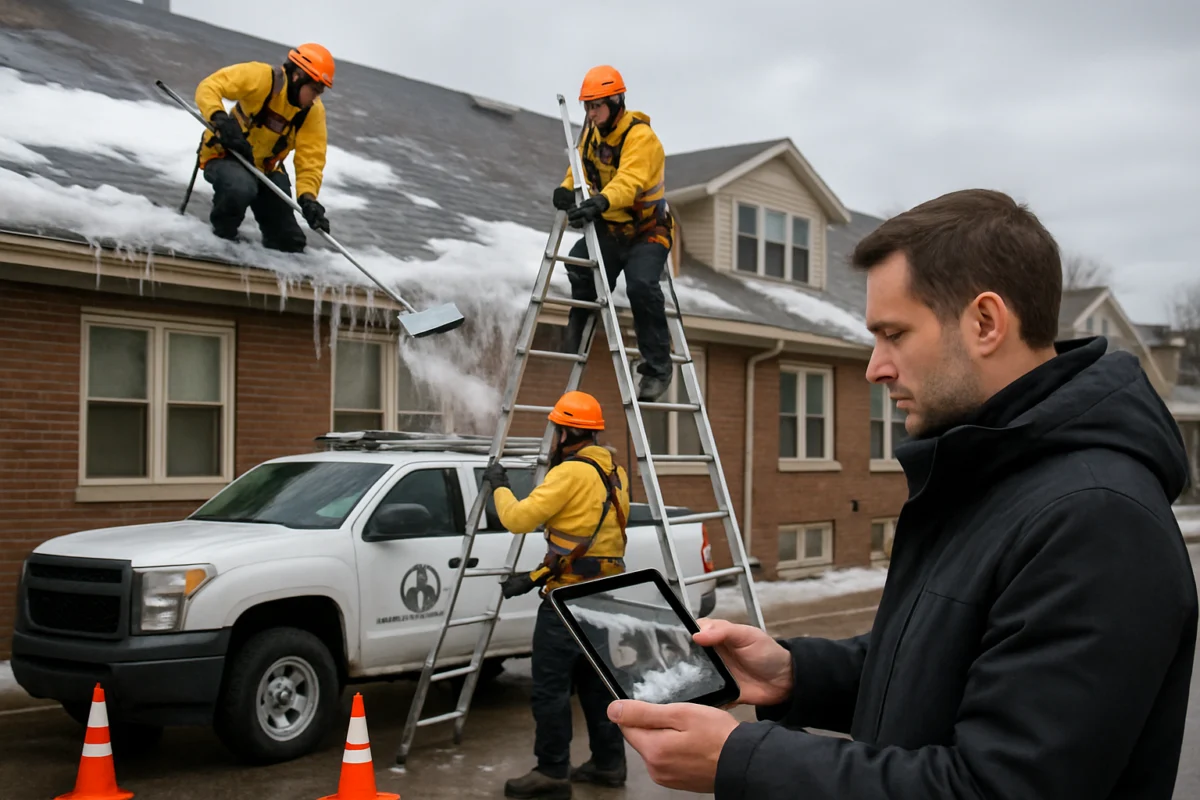
Falling is the top risk. Require helmets, harnesses tied to roof anchors, non-slip boots, and gloves rated for cold work. Train crews on ladder angles and stabilization on ice. Replace damaged PPE immediately. Property managers will expect documentation of safety procedures.
8. Document site conditions and liability steps
Take photos on arrival and departure. Note roof conditions, ice thickness, and any preexisting damage. Have property managers sign an electronic work authorization before starting emergency work. This paperwork protects you if claim disputes arise later.
Field operations checklist: from dispatch to completion
9. Initial intake script for dispatch
Train dispatch to capture these details fast: building address, contact name, best entry point, roof type and pitch if known, number of units, and whether there is active leakage. Ask if the building has rooftop HVAC or solar so techs can prepare. This intake shortens onsite assessment time.
10. Onsite triage and temporary fixes
When you arrive, do a rapid triage. If there is active leaking, install temporary roof tarps or drip pans and clear a channel in the gutter to route water away from fascia. Remove accessible ice from the gutter and ensure downspouts flow. Temporary measures buy time to plan full remediation.
11. Full remediation plan and upsell opportunities
After the emergency stopgap, present the property manager with a clear remediation plan. Recommend long-term fixes such as heat cable installation, improved attic insulation and ventilation, gutter guards designed for snow, or replacing damaged gutter segments. Provide line-item pricing so the decision is quick and transparent.
Pricing same-day emergency jobs without undercutting trust
12. How to quote on the call
Use a simple pricing framework. Charge a base emergency dispatch fee plus a per-hour rate and material costs. For multi-story or complex roofs, add a complexity surcharge. Give a fast ballpark on the phone and confirm a final price after onsite assessment. Property managers value clarity and fast follow-through.
13. Offering retainers to property managers
Convert one-off emergency calls into retainer contracts. Offer priority scheduling, discounted emergency fees, and quarterly inspections for a monthly or seasonal fee. Retainers stabilize cash flow and make your team the default vendor when thaw hits.
Communication templates property managers will appreciate
14. Confirmation and ETA messages
Send an immediate confirmation with an ETA and crew details. Use text plus email so the property manager can forward to onsite staff. Keep messages short and action oriented. Example: “Dispatch confirmed. Crew John and Maya leaving in 20 minutes. ETA 45 minutes. Will call on arrival.” Simple messages reduce confusion on site.
15. Post-job report and recommendations
After work, send a one-page report with before and after photos, a summary of actions taken, immediate costs, and recommended next steps. This report is useful for property managers who need to justify expenses to owners.
Marketing and sales: selling your same-day service to property managers
16. Targeted outreach in Minneapolis property management circles
Property managers trust peers. Attend local BOMA meetings, landlord associations, and real estate investor groups in Minneapolis. Bring case studies of ice dam jobs and carry laminated before-and-after photos. Focus on how you reduce tenant complaints and insurance claims.
17. Local SEO and hyperlocal pages
Create a landing page targeting Minneapolis and surrounding suburbs that highlights same-day ice dam response for property managers. Use phrases like “Minneapolis property manager ice dam emergency” and include service area pages for neighborhoods prone to ice buildup. Localized content helps you rank when managers search in a panic.
Tech and tools: streamline same-day workflows
18. Scheduling and dispatch platforms
Use a dispatch tool that supports urgent bookings and real-time ETA updates. Jobber, Housecall Pro, Workiz, and ServiceTitan all offer robust scheduling. Evaluate whether they integrate with your phone system and invoicing. The right platform saves time and reduces missed calls.
19. Mobile quoting and signature capture
Equip crews with mobile quoting apps that allow sending photos, getting approvals, and capturing signatures on site. The faster you generate an invoice and collect payment, the shorter the revenue cycle for high-cost same-day jobs.
20. Route optimization for multiple calls
When thaw events trigger several calls, use route optimization to minimize travel time between jobs. Prioritize active leaks and critical assets like commercial roofs. The ability to sequence work efficiently lets you cover more emergency jobs with the same crew count.
Training, quality control, and scaling
21. Onboarding and simulated emergency drills
Run simulated thaw-day drills before winter. Time the team from dispatch to completion. Train new hires on the SOP and have them shadow experienced techs. Drills expose weak links early so you can fix them without a live emergency interrupting service quality.
22. Inspect and audit every job
Assign a quality control step where a supervisor reviews photos and reports within 24 hours. Track recurring issues like missed ice channels or insufficient temporary fixes. Address patterns through training and updates to the SOP.
23. KPIs to track for scaling
Monitor these metrics during thaw season. Average response time, jobs per dispatch day, emergency revenue per day, conversion rate from emergency to retainer, and repeat customer rate. These KPIs show whether you are scaling profitably or just adding more chaos.
Handling disputes and insurance interactions
24. Proactive documentation for claims
Because property managers may file insurance claims, give them thorough documentation. Time stamped photos, signed work authorizations, and a clear scope of work help insurers see that your actions reduced risk. Keep copies for at least one year.
25. Pricing disputes and transparent invoicing
Disputes often come from surprise charges. Avoid them by providing line-item estimates and getting signoff. If additional work is required, pause and get approval before proceeding. Clear invoicing reduces late payments and saves you time in collections.
Pricing sample template for same-day ice dam jobs
Use a simple template on calls. Base emergency dispatch fee: flat fee covering travel and priority. Hourly labor rate: technician and lead rates. Complexity surcharge: roof pitch, multi-story, rooftop equipment. Materials: heat cable, tarps, replacement gutter sections. Payment terms: card on file required for emergency dispatch, invoice sent for contract work. This template keeps quoting consistent across crews and builds trust with property managers.
Real-world checklist you can print and use
Before winter
- Stock winter-specific tools and parts.
- Service and winterize trucks.
- Train rapid response crews and run a drill.
- Create SOP and mobile forms.
On a same-day call
- Dispatch intake: get building details and leak status.
- Confirm ETA via text and email.
- On arrival: take before photos and do safety check.
- Install temporary leak mitigation and clear gutter channels.
- Propose remediation plan with line-item pricing.
- Take after photos. Get digital signoff. Send report.
Post-job follow-up
- Invoice immediately and collect payment when possible.
- Log the job in CRM under property manager account.
- Schedule follow-up inspection if recommended.
- Request a quick review or testimonial.
Common mistakes to avoid
First, under-equipping your rapid response trucks. You lose time if crews have to return for parts. Second, neglecting clear pricing. Surprise fees lead to disputes. Third, poor communication with property managers. They need quick updates and simple reports. Finally, not tracking the thaw-day KPIs. Without metrics you cannot scale without stress.
Tools and vendors worth evaluating
For scheduling and dispatch, test Jobber, Housecall Pro, Workiz, and ServiceTitan to see which integrates best with your phone system and invoicing needs. For routing, pick a route optimization plugin that syncs with your dispatch. For on-site quoting and signatures, choose a mobile form app that works offline. Evaluate costs against the value of faster invoicing and fewer missed calls.
Scaling same-day ice dam response is about repeatability. Build SOPs that reduce decision points, train a stable rapid response roster, and standardize pricing. Focus on speed, safety, and clear communication with property managers. That combination makes your team the go-to vendor during thaw cycles and turns crisis calls into steady revenue.
Missed calls, poor follow-up, too many disconnected tools, and disorganization are the most common frictions that keep teams from scaling emergency work. Autopilot (www.autopilotapp.io) is an all-in-one platform for scheduling, dispatching, invoicing, calls, texting, and marketing designed to reduce those frictions. It can centralize booking, automate confirmations, and keep notes and photos linked to each property manager account so fewer jobs fall through the cracks. If you want to book more jobs and replace tool overload with a single system, it is worth a look as part of your winter operations toolkit.