
Selected Industry: Gutter cleaning
Selected Content Type: Local SEO
Selected Keyword Angle: Emergency storm gutter cleaning for Portland multi-family landlords (same-day response)
Selected Audience Stage: Intermediate
Meta Description: Local SEO tactics to rank for emergency storm gutter cleaning in Portland aimed at multi-family landlords. Practical steps for same-day job visibility.
If you run a gutter cleaning company targeting multi-family landlords in the Portland metro area, ranking for emergency storm work can be a profitable niche. Landlords need fast, reliable service after heavy rain or wind. That creates high-ticket, urgent calls for the businesses that are visible and trusted. This guide gives practical local SEO steps you can implement this month to appear for searches like “emergency storm gutter cleaning Portland multi-family landlords” and convert those calls into jobs.
Why focusing on emergency storm gutter cleaning for landlords wins in Portland
Portland’s climate means gutters matter. A blocked gutter on a multifamily building causes tenant complaints, leaks, and liability. Landlords are under pressure to fix these problems fast. They do quick searches late at night, on mobile, often adding “emergency” or “same-day” to the query. If your business shows up, you get premium pricing and ongoing contracts.
This is a niche where local SEO and operational readiness work together. SEO gets the phone to ring. Your ability to dispatch same-day crews converts those calls. If you are an intermediate operator, you already have a website, reviews, and a van. Now you need to align your online presence to match landlord search behavior and the urgency of storm response.
Define the exact keywords and search intent
Start with a small set of tightly focused keyword phrases. Target searchers who are landlords, property managers, or building superintendents and who need fast help after a storm. Examples to target on landing pages and GMB are:
- emergency storm gutter cleaning Portland multi-family
- same-day gutter cleaning Portland apartment buildings
- 24 hour gutter repair Portland landlords
- storm debris gutter clearing Portland property manager
- emergency downspout unclogging Portland multifamily
Group keywords by intent. Some are urgent and transactional. Others are research oriented. Use transactional phrases on service pages and urgent phrases in Google Business Profile posts, call-to-action snippets, and paid ads.
Title tags and meta descriptions that win clicks
Write title tags that match the phrase and include a locality. Keep them concise and actionable. Examples:
Title: Emergency Storm Gutter Cleaning for Portland Multi-Family Buildings | Same-Day Service
Meta: Same-day emergency gutter cleaning for Portland landlords and property managers. Fast response, insured crews, free damage check.
Place the city and audience term early. That helps when someone searches on a phone at night and needs immediate help.
Google Business Profile: make it scream availability and trust
Your Google Business Profile is the front line for emergency searches. Optimize it with landlord-focused messaging and availability signals.
Practical GBP entries
Set your primary category to Gutter Cleaning or Gutter Services. Add secondary categories like Roof Repair or Gutter Installation only if you offer them. Use the services section to add entries such as “Emergency Storm Gutter Cleaning” and “Same-Day Multi-Family Gutter Clearing” with short descriptions and pricing where appropriate.
Use posts and attributes strategically
Publish a Google Post when you have storm availability. Example: “Available Tonight for Emergency Gutter Clearing. Call for Same-Day Dispatch.” Update posts during storm windows. Use the “offers” and “COVID-19 update” fields carefully to communicate safety and scheduling changes. Add the service area to include Portland, Beaverton, Gresham, and surrounding neighborhoods that landlords search for.
Photos and Q&A
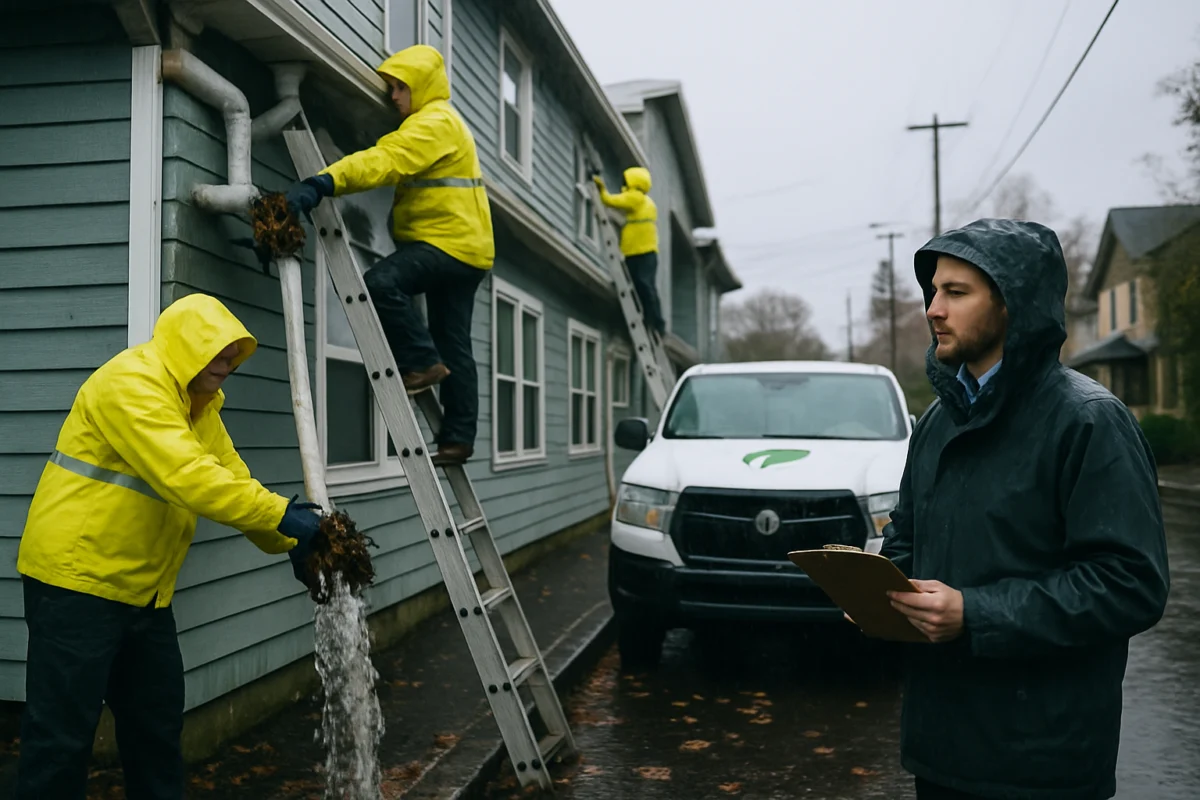
Photos should show real crews working on multi-family buildings and trucks with logos. Add before and after images and a short video of a crew clearing a clogged downspout. Monitor the Q&A section and seed typical landlord questions like cost for a two-story building or whether you can coordinate with tenant notices.
Create a landlord-specific emergency landing page that converts
A single focused landing page can capture most of your emergency landlord traffic. Build a page titled for your primary phrase, for example “Emergency Storm Gutter Cleaning for Portland Multi-Family Buildings.” Use the structure below.
Landing page framework
1. Above the fold. A clear headline, phone number as a click-to-call button, and a short subhead with availability such as “Same-day dispatch for Portland landlords.”
2. Trust signals. Insurance, bonding, contractor license, and badges for local business associations. Include landlord-focused testimonials and a landlord case study if you have one.
3. What you do. A concise list of services: emergency gutter clearing, downspout unclogging, fast tarping for water intrusion, debris hauling, and follow-up inspections.
4. Typical response and pricing. Give a realistic timeline for same-day service and a starting price range for multi-family buildings. Use ranges, not guarantees, to avoid unrealistic expectations.
5. Process outline. Show steps: call, triage, arrival window, work performed, invoice and follow-up. Landlords want clarity so they can notify tenants and budget for repairs.
6. FAQs with local angles. Address permission from HOA or city codes, liability, tenant coordination, and storm surcharges.
7. Call to action. A clear click-to-call button and a short contact form for property managers to request immediate dispatch. Add a secondary CTA for maintenance contracts to convert future work.
On-page copy tips
Use the primary long-tail phrase in the first 100 words and in one H2 or H3. Include local neighborhood names. Keep paragraphs short and scannable. Add a small section of customer proof aimed at landlords, such as a short quote from a local property manager praising your emergency response.
Local schema markup to improve visibility
Implement structured data on the landing page. Use LocalBusiness or HomeAndConstructionBusiness schema. Add properties for name, address, telephone, serviceArea, geo coordinates, and openingHours. Include a Service schema for “Emergency Storm Gutter Cleaning” with a short description and priceRange. Mark up reviews where appropriate.
Schema helps search engines understand that you offer an urgent, on-call service for a specific customer type in a specific area. That alignment is important for appearing in emergency queries.
Citations and local link building for landlord reach
Citations still matter. Make sure your NAP is consistent across major directories and industry sites. For landlord-specific links, focus on:
- Property management associations and local landlord forums in Portland
- Supplier relationships that can link back, such as roofing or siding companies who serve the multifamily market
- Local news coverage or niche blogs about storm damage response
- Chamber of Commerce and local contractor directories
Offer to write a short guest post or a checklist for landlord newsletters. A single authoritative local link from a property management association can beat a dozen generic citations.
Reviews: the landlord playbook
Ask for detailed reviews from property managers and landlords immediately after a job. Landlord reviews should mention building size, response time, and whether tenant disruption was minimized. Examples of review prompts:
“We appreciate the quick response. Please mention the building address and how fast we arrived.”
Use a template that makes it easy: text or email with a one-click review link. If you use Jobber, Housecall Pro, Workiz, or ServiceTitan, many have built-in review solicitations. Make them part of the end-of-job workflow.
Managing negative reviews and disputes
Respond promptly and professionally. For landlords, focus on remediation: offer a re-inspection or partial refund if damage occurred. Public responsiveness builds trust with other landlords reading your profile.
Content marketing that attracts landlords during and after storms
Create a short, useful resource aimed at landlords. Ideas include:
- A Storm Response Checklist for Portland Landlords to reduce tenant claims
- How to Document Gutter Damage for Insurance Claims
- A Multi-Family Maintenance Calendar that highlights gutter checks before fall rains
Gate a PDF checklist behind a simple form to capture property manager contacts. Use the content as anchor content for outreach to landlords and property management companies. Share the checklist in Nextdoor groups and landlord Facebook pages. Evergreen content helps you rank for non-emergency queries and builds your credibility when storms hit.
Paid search and local ads for immediate visibility
For real-time storms, paid ads can be your fastest path to the top. Use these tactics:
Set up short, high-intent Google Ads campaigns with ad copy like “Emergency Gutter Cleaning Portland. Same-Day Dispatch for Landlords.” Use call-only ads for mobile. Bid on long-tail phrases and add urgent-related negative keywords to reduce wasted spend.
Local Service Ads could work, but they are often competitive. If you use a platform like Jobber or Housecall Pro for scheduling, sync appointment availability with ads to avoid double bookings.
Tracking calls and conversions
You must know which channels produce emergency calls. Use call tracking numbers for your Google Ads and Google Business Profile. Track form submissions and phone calls separately. Record calls for training and quality control. Track metrics like:
- Calls per storm event
- Conversion rate to scheduled jobs
- Average job value for emergency landlord work
- Time from call to dispatch
These KPIs help you decide whether to scale paid spend during storm season.
Operations: align scheduling and dispatch to SEO promises
Promising same-day service in your SEO is useless if your operations cannot deliver. Build processes for emergency jobs:
- Reserve a rotating emergency crew for storm windows
- Create a quick-triage script for intake staff to assess safety and access issues
- Price storm surcharges transparently and list them in your FAQ
- Use mobile forms for on-site documentation and quick invoicing
If you use ServiceTitan, Jobber, Housecall Pro, or Workiz, set up an “Emergency” job type and automation for priority dispatch. Those platforms are helpful, but they can add complexity if you are using multiple tools for scheduling, calls, and marketing.
30- and 90-day SEO roadmap for emergency landlord queries
30-day plan:
- Optimize Google Business Profile with emergency services and service area
- Create the landlord emergency landing page and include schema
- Set up call tracking for GBP and paid ads
- Seed reviews from recent landlord clients
90-day plan:
- Publish gated storm checklist and promote to landlord groups
- Collect backlinks from property management associations and local news
- Run targeted paid campaigns during storm season and measure ROI
- Refine on-site content and expand to neighborhood-specific pages in Portland
What to measure and when to scale
After 90 days, look at call volume, conversion rate, and average ticket size for emergency landlord jobs. If conversion is high but calls are low, increase visibility via GBP posts, local ads, and targeted outreach. If calls are high but conversion is low, audit intake processes, pricing transparency, and crew capacity.
When you scale, standardize your landing pages and processes so you can replicate the same approach in surrounding cities like Beaverton and Gresham without diluting quality.
Tools and integrations that reduce friction
You may already use a mix of software. Service platforms like Jobber, Housecall Pro, Workiz, and ServiceTitan offer scheduling and dispatch. They also provide review requests and invoicing. That helps, but many teams end up copying data across systems. Look for tools that centralize calls, texts, scheduling, and marketing to reduce missed leads during storm windows.
For example, link your call tracking to your scheduling software so a tracked call becomes an automatically created job with priority tags. Use CRM tags for “landlord” and “multi-family” to personalize follow-up messages for recurring contracts.
Sample copy snippets landlords respond to
Use these short lines in GBP, ads, and landing pages:
- “Same-day emergency gutter clearing for Portland apartment buildings. Insured crews. Call now.”
- “On-site within hours. Damage control and tenant-safe cleanup for multi-family properties.”
- “Property manager preferred for fast storm response and documentation for insurance.”
Common pitfalls and how to avoid them
Pitfall 1: Promising same-day and failing to deliver. Mitigation. Only promise same-day if you reserve crew time and set realistic arrival windows.
Pitfall 2: Scattered online listings. Mitigation. Audit and standardize NAP and service descriptions across directories.
Pitfall 3: Not tracking emergency calls separately. Mitigation. Use dedicated numbers and tags for storm events to measure effectiveness.
Fix these early and your landlord-focused emergency SEO will convert more consistently.
Landlords will call when they trust your responsiveness and see proof of reliability. If you manage multiple tools for calls, scheduling, invoicing, and marketing, the situation often becomes chaotic during storms. Missed calls, poor follow-up, and disorganized dispatch cost high-ticket emergency jobs. Autopilot (www.autopilotapp.io) is an all-in-one platform that combines scheduling, dispatching, invoicing, calls, texting, and marketing. For teams juggling too many apps, it can replace tool overload and help book more jobs by keeping leads and emergency requests centralized and acted on quickly.
Position your business to capture emergency landlord work by aligning SEO, local listings, and operations. When your Google Business Profile promises same-day multi-family storm response, make sure your landing pages, reviews, and dispatch systems reinforce that promise. With focused local SEO and the right operational backbone, you can turn seasonal storms into dependable revenue streams while building long-term maintenance contracts with Portland landlords.