
Selected Industry: Gutter cleaning
Selected Content Type: Local SEO
Selected Keyword Angle: emergency ice dam gutter cleaning for property managers in Minneapolis during winter slow season
Selected Audience Stage: Scaling
Title: How to Win Ice-Dam Emergency Gutter Cleaning Contracts from Property Managers in Minneapolis: A Local SEO and Operations Playbook for Scaling Gutter Companies
Meta Description: Target property managers in Minneapolis with a local SEO and operations playbook to book ice-dam emergency gutter cleaning jobs and scale reliably.
If your gutter company already has steady residential work but you want to scale into larger, recurring contracts, targeting property managers for ice-dam emergency gutter cleaning in Minneapolis is a practical next step. This article is a tactical playbook. It covers local SEO that actually converts, price and operations playbooks for emergency response, outreach templates, and the systems you need to handle more same-day, high-value jobs without chaos.
Why focus on property managers and ice-dam emergencies in Minneapolis
Property managers are high-value customers. They oversee multiple multi-family buildings, commercial rentals, and HOA communities. One single contract can deliver repeat work across seasons. In Minneapolis, cold snaps and freeze-thaw cycles create ice dams every winter. Ice dams are urgent. They can cause leaks, interior damage, and frustrated tenants. That urgency means property managers will pay premium rates for reliable same-day removal and preventative measures.
Targeting this niche gives your business three advantages. First, you sell urgency, not price. Second, you reduce seasonality by offering emergency response. Third, you build long-term contracts for maintenance and prevention work.
Understanding the job: ice-dam gutter cleaning essentials
What is an ice dam and why gutters matter
An ice dam forms when heat from the roof melts snow at the eave. Meltwater runs down and refreezes at the gutter line. That creates a barrier that keeps melting snow trapped behind it. Water pools and can back up under shingles, causing leaks and interior damage. Gutters clogged with debris or ice worsen the problem.
Typical scope for emergency jobs
- On-site assessment for safety and roof access.
- Tool setup: roof rakes, heat cables, steamers, low-impact roof de-icing, and ice chippers.
- Ice and snow removal above the gutter line, including channels of meltwater to downspouts.
- Clearing debris from gutters and downspouts to restore flow.
- Temporary fixes, documentation, photos, and follow-up maintenance plan.
Safety and liability
This is not a DIY job for inexperienced crews. Falls, roof damage, and ice falls are real risks. Train crews on fall protection, ladder safety, and low-temperature equipment handling. Update your insurance and clarify limits on emergency contracts. Many property managers will request proof of insurance and W9s before awarding work.
Local SEO that finds property managers actively searching for help
Local SEO is the foundation for being chosen when an emergency hits. Property managers search by problem, location, and urgency. They use phrases like “ice dam removal near me”, “emergency gutter cleaning Minneapolis”, and “commercial ice dam removal for property managers”. Your content and local presence must match those searcher intents precisely.
Google Business Profile optimization
- Business name: Keep it brand first, not keyword stuffed. Use your company name and a primary category of “Gutter Cleaning” or “Roofing” depending on services.
- Primary category: Gutter Cleaning. Secondary category: Roof Snow Removal or Roof De-Icing if available.
- Business description: Lead with your proposition. Example: “Same-day ice dam removal and emergency gutter clearing for Minneapolis property managers. Licensed, insured, and available 24/7 in winter.”
- Attributes: Add service areas covering Minneapolis neighborhoods and suburbs property managers serve.
- Photos: Post recent photos of crews removing ice dams, commercial multi-family properties, and before-after shots with timestamps.
- Posts and Google Q&A: Publish frequent posts during winter. Use Q&A to seed answers property managers may ask, like minimum response times and insurance details.
Service pages that convert
Create a focused landing page titled precisely for your long-tail keyword. Example URL: /minneapolis-ice-dam-removal-for-property-managers. The page should include:
- Headline that matches search intent.
- Clear list of services included in an emergency response.
- Service area section listing Minneapolis neighborhoods and nearby cities.
- Proof: photos, testimonials from property managers, and case studies.
- CTA: same-day booking number and a short form requesting property details and urgency level.
Local content and topical authority
Write cluster content around ice dam prevention for property managers. Ideas:
- Checklist: Winter roof inspections for Minneapolis property managers.
- Comparison: Pros and cons of heat cables vs roof steaming for multi-family buildings.
- Costs and timelines: Typical emergency ice dam removal for 2-6 unit buildings in Minneapolis.
This content builds authority and helps internal linking to your service page.
Local citations and industry listings
Ensure consistent NAP across directories property managers use: BBB, building manager forums, local property management associations, and trade pages. A listing on regional property management portals can be a direct source of contracts.
PPC and targeted ad tactics for emergency searchers
PPC complements SEO for emergencies. When an ice dam forms, property managers search now. Run a small targeted campaign for winter months with ad copy tailored to property managers.
- Keywords: exact-match phrases like “property manager ice dam removal Minneapolis” and phrase match for broader emergency terms.
- Ad copy: Lead with speed and credentials. Example: “Same-Day Ice Dam Removal for Property Managers. Insured, Commercial Experience. Call Now.”
- Landing page: Route traffic to your Minneapolis property manager landing page, not the homepage.
- Ad extensions: Use call extensions, location, and site links to your emergency response page.
Outreach and sales playbook for property managers
Property managers are organized buyers. They respond to concise, credentialed outreach that shows you understand their constraints. Use this playbook to get meetings, quotes, and preferred vendor status.
Prospecting list building
- Source lists from local property management associations and LinkedIn searches for “property manager” + “Minneapolis”.
- Filter for companies that manage multi-family or HOA portfolios. Single-property landlords are lower value for this strategy.
- Prepare a spreadsheet with company name, property addresses, phone numbers, and best contact emails.
Cold email template for property managers
Subject: Minneapolis ice-dam response plan for [Company Name]
Hi [Name],
When Minneapolis temperatures swing, ice dams can cause leaks and tenant complaints overnight. We help property management teams stop interior damage fast. We provide same-day ice-dam removal, written documentation for your maintenance files, and a seasonal prevention plan for multi-family properties in Minneapolis.
If you have a preferred vendor process, I would like to share our insurance, references, and a 12-hour response SLA. Can I send details for one of your properties or schedule a 10-minute call this week?
Thanks,
[Your name], [Company]
Phone script for urgent calls
- Identify: Ask if they are the point person and get the property address.
- Assess: “Is there visible water entry or active leaks? How many units affected?”
- Commit: Offer an arrival window. Example: “We can be on site within 3 hours. We will assess, remove ice dams, and clear gutters to restore drainage.”
- Reassure: Mention insurance, crew training, and provide an estimated minimum call-out fee and range for typical jobs.
Pricing and packaging for emergency ice-dam work
Pricing must reflect urgency, risk, and property scale. Avoid per-linear-foot pricing for emergencies. Use tiered emergency packages to simplify sales and avoid scope creep.
Sample pricing tiers
- Rapid Response Minimum: Base fee that covers arrival, assessment, and up to one hour of labor. Use this to filter low-value calls.
- Small Building Package: For 2-6 unit buildings. Includes de-icing of eaves and gutter clearing.
- Large Building or Complex Package: For multi-building properties. Price on inspection plus a mobilization surcharge.
- Preventative Maintenance Add-On: Seasonal contract for late fall roof inspection and preemptive heat cable installation or monthly monitoring.
Always add a safety or liability surcharge when rooftop work is required or when crew must use powered steamers or chippers.
Simplify approvals for property managers
Many property managers need quick approvals. Offer a one-page scope of work and a tiered quote with estimated ranges. Include short terms for emergency work that allow verbal approvals for under a certain dollar threshold. That reduces friction and speeds booking.
Operations playbook to deliver same-day, high-quality service
Staffing and scheduling
- Keep an on-call crew during winter months. Rotate shifts and keep overtime predictable.
- Cross-train crews on ice removal techniques, ladder safety, and tenant interaction protocols.
- Maintain a rapid dispatch checklist you can read off the phone to gather address, access instructions, and hazard notes.
Equipment checklist
- Roof rakes, telescopic ice tools, and safe ice chippers.
- Low-temperature steamers or hot water systems designed for roof work.
- Heat cables and supplies for temporary or permanent installations.
- Fall protection gear, ladders with stabilizers, tarps, shovels, and generators.
Job flow for emergency calls
- Dispatch: Assign crew and estimate arrival time. Send confirmation to the property manager with ETA and crew photos.
- On-site assessment: Photograph the problem, identify points of water entry, and create a short scope for approval.
- Execution: Remove ice dams in channels to restore flow to downspouts, clear gutters, and document completed work.
- Follow-up: Provide a written report with before-and-after photos and recommended next steps like heat cable installation or planned maintenance.
Standardize documentation
Property managers appreciate neat records. Use templated reports that include time on site, crew names, photos with timestamps, materials used, and safety notes. This makes invoicing easier and strengthens your case for repeat business.
Retention strategies: turn emergency calls into contracts
After you clear an ice dam, you are in the strongest position to sell maintenance. Use these strategies to convert one-off emergencies into recurring revenue.
- Immediate follow-up email with photos, a short summary, and three recommended options: one-time repair, seasonal monitoring, or full preventative package with heat cable installation.
- Offer a discounted yearly contract when signed within 30 days of the emergency job.
- Provide access to a priority scheduling line for contract holders to guarantee a faster SLA.
- Ask for a testimonial from the property manager and permission to use their logo as a client reference if the job went well.
Measuring success and KPIs to track
To scale, measure what matters. Track these KPIs monthly during winter months.
- Response time: Average arrival time from call to on-site.
- Conversion rate: Percentage of emergency calls that convert to paid jobs.
- Retention: Percentage of emergency clients who sign seasonal contracts within 90 days.
- Avg ticket: Average revenue per emergency job.
- Customer satisfaction: Post-job rating from property managers.
Tech stack and tools that reduce friction
Growing companies need systems to replace reactive chaos. Common tools include Jobber, Housecall Pro, Workiz, and ServiceTitan. Each has strengths. Jobber and Housecall Pro are great for small-to-mid teams and simple scheduling. ServiceTitan is more full-featured for larger operations but costs more. Workiz handles dispatch and has good call tracking integrations.
Key features to prioritize:
- Real-time dispatch and ETA texts.
- Mobile work order management with photo attachments and signature capture.
- One-click invoicing and quick payment options for property managers who require fast turnaround.
- Call tracking and recording so you can optimize outreach and responses.
Scripts, templates, and checklists you can use today
Emergency intake form checklist
- Caller name and role.
- Property address and access instructions.
- Report of active leaks or tenant impact.
- Preferred contact for approvals and billing method.
- Any rooftop hazards or locked mechanical areas.
Post-job report template
Keep it short. Include date/time, crew names, summary of work, materials used, before and after photos, recommended follow-up, and invoice summary.
Common pitfalls and how to avoid them
- Underpricing emergencies. Ensure your minimum covers mobilization, overtime, and safety risk.
- Poor documentation. Without photos and timestamps, disputes on scope or damage claims become headaches.
- Too many tools. Using separate apps for bookings, texting, payments, and marketing creates friction and missed follow-ups.
- Failing to train crews on tenant communication. Property managers value a calm, professional interaction when tenants are upset.
Real-world mini case study: quick wins from a Minneapolis contractor
One Minneapolis gutter company shifted focus to property managers three winters ago. They created a Minneapolis-specific ice-dam landing page and ran a small PPC campaign during December through March. They standardized an emergency minimum fee and a one-page scope for quick approvals.
Results in the first winter:
- Average response time dropped from 6 hours to 2.5 hours.
- Conversion of emergency calls to paid jobs rose to 78 percent because of clearer pricing and faster arrival.
- They closed three annual contracts with property management firms, which provided predictable revenue and priority scheduling.
Key takeaways: focus on speed, keep pricing simple, and make documentation a product you sell. Property managers pay a premium for reliable records and tight SLAs.
Checklist: launch plan for targeting property managers this winter
- Create a Minneapolis property manager ice-dam landing page.
- Optimize Google Business Profile for winter emergency search terms.
- Launch a targeted PPC campaign for winter months.
- Build an outreach list of local property managers and send the cold email template.
- Stand up a winter on-call schedule and kit your crews with safety gear.
- Prepare templated reports, invoices, and a rapid authorization form.
- Track KPIs weekly and iterate on response time and conversion scripts.
How to win trust quickly with property managers
Trust is the currency in property management. You earn it with fast response, clean documentation, and consistent follow-up. Make each emergency job an opportunity to prove your processes. Offer a mini-retainer or priority line for regular clients. Provide evidence of insurance and references on your sales sheet. Those steps reduce buying friction and help you win preferred vendor status.
If you are juggling missed calls, messy follow-up, and too many apps to manage bookings, an all-in-one system can help. Autopilot (www.autopilotapp.io) offers scheduling, dispatching, invoicing, calls, texting, and marketing in one platform. Using a single system helps you answer calls faster, keep a clear audit trail for property managers, and replace tool overload so you can book more high-value emergency jobs with less admin.
Start small. Implement the local SEO and outreach steps first. Build an on-call team and standardize pricing. Use documentation and quick turnaround to convert emergency work into steady contracts. When systems become the bottleneck, consider consolidating tools so you can focus on speed and reliability. That combination is what wins property manager business in Minneapolis winter after winter.
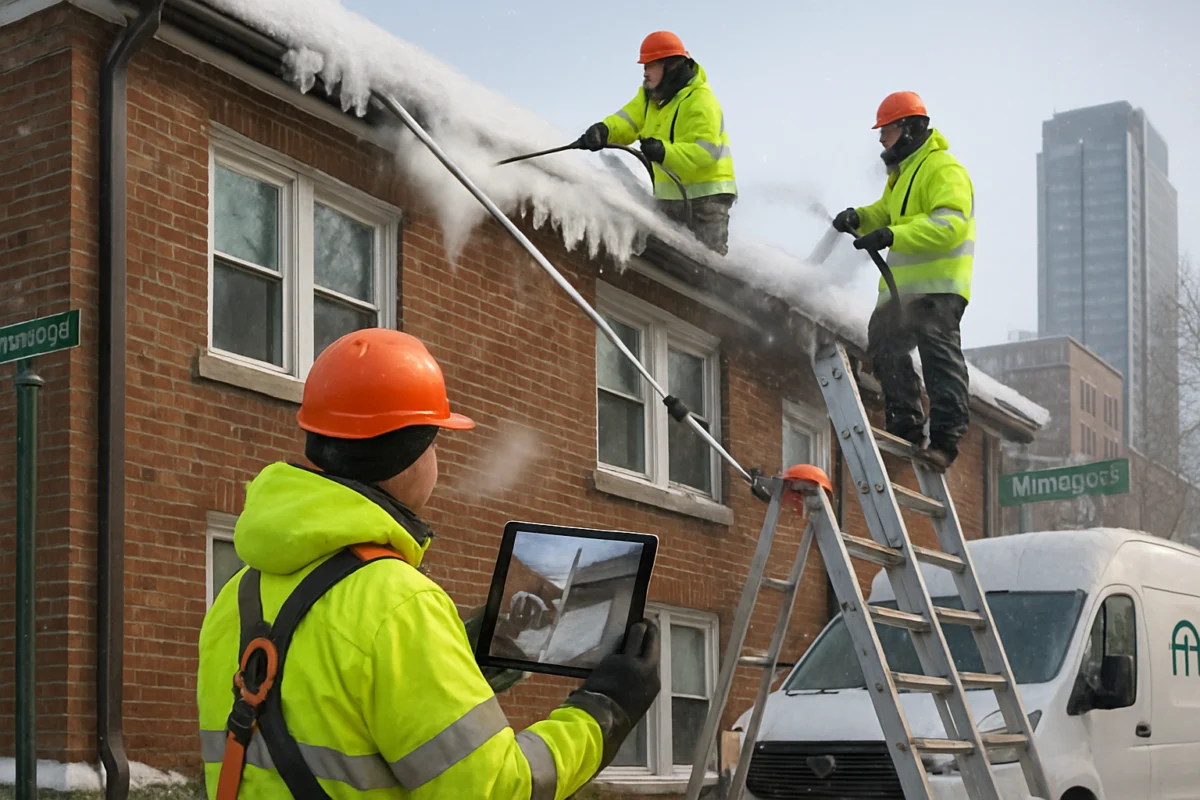
Image prompt: A photorealistic winter scene showing a professional gutter and roof crew removing an ice dam from a multi-family brick building in Minneapolis. The foreground shows two crew members in insulated high-visibility jackets using a telescopic roof rake and a low-temperature steamer on the eave, while another crew member secures a ladder with a stabilizer and wears a fall protection harness. There are visible before-and-after sections of roof eave with ice removed. Include city elements like a Minneapolis street sign and lightly falling snow. The lighting is cold daylight, realistic textures, visible breath vapor, company van parked with a visible but generic logo, and clear focus on teamwork, safety equipment, and documentation with one crew member holding a tablet displaying photos. Photorealistic, high resolution, natural color grading.
Image keywords: Minneapolis ice dam removal