
Selected Industry: Pool service
Selected Content Type: Operations playbook
Selected Keyword Angle: same-day emergency algae treatment for Miami property managers during rainy season
Selected Audience Stage: Scaling
Meta Description: Operations playbook for scaling pool services to handle same-day algae emergencies for Miami property managers during rainy season.
If your pool service company is scaling and you want to own the same-day emergency algae niche for property managers in Miami during rainy season, this is the practical operations playbook you need. This guide walks through triage, dispatch, SOPs, pricing framework, training, and the small systems that stop chaos when storms trigger spikes in algae calls.
Why same-day algae response matters for property managers in Miami
Property managers face resident complaints, potential liability, and contract penalties when community pools turn green or close. During Miami’s rainy season, heavy storms and warm water create algae blooms that move fast. If you can reliably show up the same day, diagnose, and stabilize the pool, you win repeat business and preferred-provider status.
Same-day response is not just marketing. It protects health, preserves pool surfaces, and reduces costly filter and plaster damage. For scaling operations, it also becomes a predictable revenue stream when run with clear SOPs.
How to pre-qualify an emergency algae call on the phone
Proper triage starts before you dispatch a truck. Train intake staff or your answering service to get the right facts in under three minutes. That saves time, prevents mis-dispatches, and makes techs more effective on arrival.
Essential intake questions
Ask these to qualify urgency and scope.
- Is the pool open to residents now, or is it already closed?
- How long has the water looked cloudy, green, or discolored?
- Are there visible floating scum, film, or hairlike patches on walls?
- Have any recent chemicals been added? When and what?
- Is there a filtration issue or low water level?
- Do you have a pool cover, and is there a power outage?
Triage categories
Sort calls into three quick buckets so techs carry the right gear.
- Rapid response – heavy green water, residents complaining, pool in use. Send same-day crew with superchlorination supplies.
- Standard emergency – visible algae and early-stage cloudiness. Same-day or next-morning response depending on access.
- Non-urgent – light discoloration, no resident impact. Schedule during regular route if the customer prefers cost savings.
Dispatching and scheduling for same-day response
Running same-day jobs requires surgical dispatching. You need a consistent process that matches crew skills, location, and truck stock to each job type. Route clustering in Miami neighborhoods and zoning by traffic patterns will cut drive time and increase capacity.
Rules for rapid dispatch
- Always assign at least one technician trained in algae remediation per rapid-response truck.
- Keep a rapid-response truck stocked with common emergency chemicals and a portable vacuum or pump.
- Block out a floating time window in each techs schedule for one emergency call per day during rainy season.
- Use zone-based routing so crews cover compact neighborhoods instead of wide, inefficient areas.
Software and tooling
Scheduling software can automate most of this. Tools like Jobber, Housecall Pro, Workiz, and ServiceTitan handle dispatch and routing. Each has trade-offs. Jobber is lightweight and easy for smaller teams. Housecall Pro is user friendly for field techs. Workiz has good dispatch features for high call volume. ServiceTitan is enterprise focused and powerful but can be heavier to implement. Choose software that integrates with your phone system and lets you push job updates and photos to property managers quickly.
Step-by-step SOP for a same-day emergency algae treatment
Below is an operational checklist a tech follows from arrival to handoff. Keep steps short and repeatable so junior techs can execute under pressure.
Arrival and initial assessment
1. Take photos of the pool and equipment and timestamp them. These become proof for the manager and documentation for follow-up.
2. Test water: pH, chlorine, alkalinity, cyanuric acid, and visible clarity. Record results in the job notes.
3. Inspect equipment: pump running, skimmer baskets clear, filter pressure, return jets operating.
Immediate actions
1. If pump is off, get circulation on first. Running the pump is often the fastest way to start improving conditions.
2. Remove surface debris, leaves, and floating algae with nets.
3. Brush all surfaces thoroughly to break algae colonies. Use a stiff brush for tile and a soft brush for delicate finishes.
Chemical protocol and handling
1. Follow product label instructions. For rapid remediation, superchlorination plus an algaecide is a common approach. Use a chlorine shock product rated for algae treatment where appropriate.
2. Add treatments in small, controlled doses while monitoring pH and chlorine. Safety is critical. Use gloves and eye protection, and keep chemicals in labeled, ventilated storage on the truck.
3. If heavy particulate remains, use flocculant to gather particles for vacuuming. For problem algae types, specific algaecides or brush-and-vacuum cycles may be required.
Filtration and vacuuming
1. Backwash or clean filters as needed. If cartridge filters are clogged, have a spare cartridge or plan for vacuuming to waste when rules allow.
2. Use a portable vacuum or waste line to remove the floating mass and floc particles. Vacuum to waste if possible to avoid recirculating debris through the filter.
Handoff and follow-up
1. Leave a job summary and photos for the property manager with next-step expectations, including recommended follow-up window, likely time to clear, and any access or electrical issues.
2. Schedule a 24 to 72 hour follow-up check. Document the follow-up in your system and set reminders.
Equipment and consumables checklist for rapid-response trucks
Stocking the right items prevents wasted trips. Keep a dedicated rapid-response kit that stays in the truck during rainy season.
- Test kits and digital readers for fast recording
- Chlorine shock, granular or liquid, and labeled algaecides for different algae types
- Flocculant and polymer treatments
- Portable vacuum and waste hose for vacuum-to-waste
- Stiff and soft brushes, leaf nets, skimmer poles
- Replacement filter cartridges, pressure gauge, and backwash hose
- PPE: gloves, goggles, spill kit
- Camera or phone with good lighting for documentation
Pricing framework for same-day emergency algae treatments
Avoid one-size-fits-all flat rates. Use a transparent formula so property managers understand charges and you protect margins under surge conditions.
Simple pricing formula
Base trip fee. Covers travel and guaranteed response window. This helps offset last-minute scheduling.
Plus hourly labor. Include two techs for heavy jobs. Hourly rates should consider overtime during storms.
Plus chemical cost. Pass through actual chemical cost with a small handling fee or include typical chemical packages with clear descriptions.
Plus disposal or vacuum-to-waste fees. If you must vacuum to waste, state the environmental handling fee.
Plus a priority surcharge for guaranteed same-day service during peak windows. This preserves capacity and discourages non-urgent emergency bookings.
Price transparency and contracts
Offer property managers a tiered emergency plan. For example, a retainer or monthly priority fee can lock in response windows and give you predictable cash flow during rainy seasons. For scaling businesses, a small retainer for preferred status pays for faster dispatch during storms.
Communication templates property managers will appreciate
Clear, short communication reduces repeat calls and builds trust. Create templates your intake team and techs can use for consistency.
Initial confirmation text
Thanks. We received your algae report. Crew assigned. ETA 2 hours. Technician will call on arrival and send photos before and after. Contact: [Tech Name] [Tech Phone].
On-site arrival message
On site now. Performing assessment and tests. We will text photos and next steps in 20 minutes.
Completion message
Job complete. Photos and test results attached. We recommend a follow-up visit in 48 hours to confirm clarity. Invoice and service notes will be emailed.
Managing multiple same-day calls in a rainy season surge
When calls spike, your systems decide whether you scale successfully or burn out your team. Prioritize, triage, and use temporary fixes to stabilize more pools quickly.
Prioritization rules
- Pool open and in use gets top priority.
- Pools with visible hazards or overflow issues come next.
- Insular private pools may be scheduled later if the property manager requests it.
Workload expansion strategies
1. Cross-train general techs to perform basic algae triage so senior techs handle the worst cases.
2. Consider short-term subcontracting for manual work like vacuuming and heavy brush-out on weekend surges.
3. Run two-shift coverage during peak months to extend daylight capacity without burning overtime in one long shift.
Training, QA, and documentation
Scale by making knowledge repeatable. Create short micro-training sessions and require photo-based QA for every emergency job.
Training checklist
- Basics of algae types and visual ID
- Safe chemical handling and dilution practices
- Brushing and vacuum techniques
- Filter maintenance and backwash decision rules
- Customer communication and photo documentation
Quality assurance
Require techs to upload before and after photos and recorded test results to the job record. A dispatcher or operations manager should spot-check 10 to 20 percent of jobs during rainy season for consistency.
Common troubleshooting scenarios and fixes
Even with best practices, some jobs need follow-up. Prepare scripts and SOPs for the known trouble spots.
Persistent cloudiness after initial treatment
Check circulation and filter. Often the issue is poor flow or clogged filters. Run extended filtration cycles or vacuum to waste while backwashing the filter.
Recurring algae returns
Investigate CYA levels, phosphate sources, and sunlight exposure. Work with property managers to reduce nutrient sources such as landscape runoff. Consider installing phosphate remover when appropriate.
Filter media that will not clear the water
If sand or DE media is contaminated with organic load, a deep clean or media replacement may be needed. Document the escalated recommendation and estimate separately.
Example run: three same-day jobs in Miami rainy season
Picture a Tuesday morning with heavy showers overnight. Intake fields three calls by 8 a.m. Dispatcher zones jobs by neighborhood and assigns a rapid-response truck for the worst green pool and two route trucks for early-stage cases.
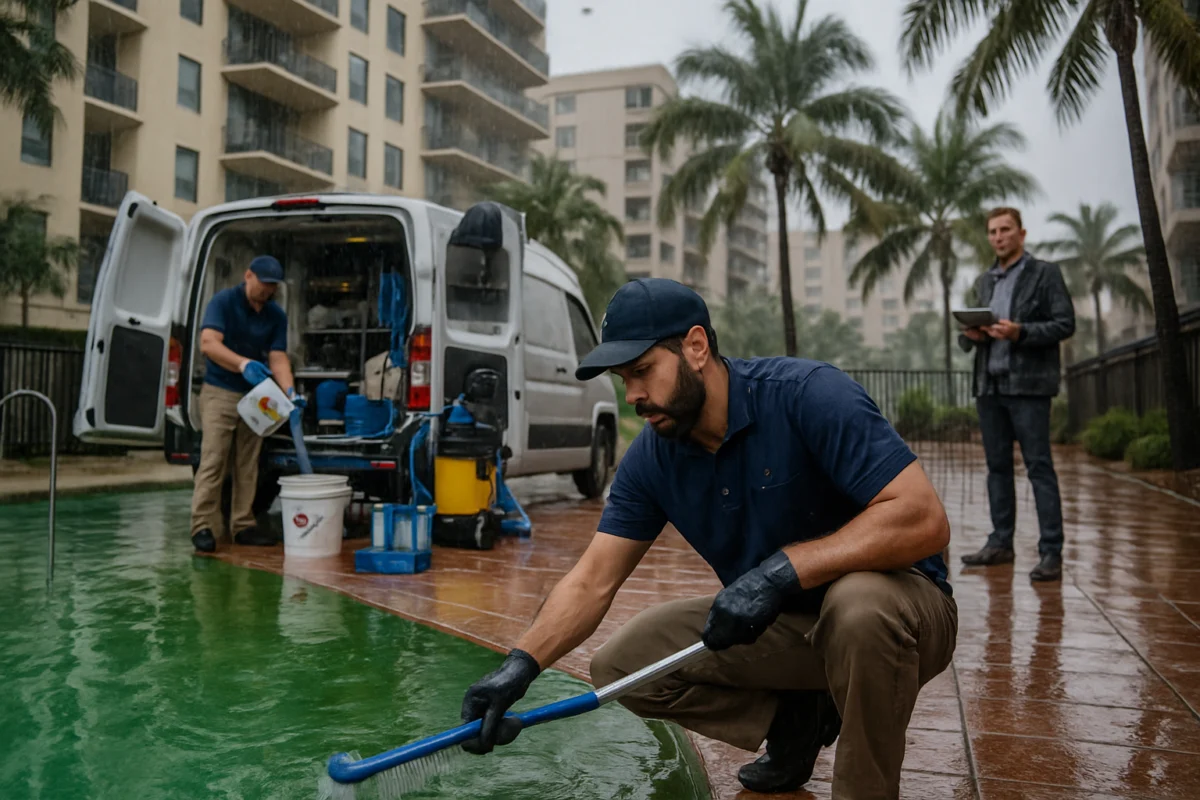
Rapid-response crew arrives at an HOA pool with residents complaining. They restore circulation, brush, perform superchlorination, vacuum to waste, and upload before and after photos. The job is documented, a 48-hour follow-up is scheduled, and the property manager is given a clear invoice line for chemicals and priority fee.
The route trucks handle a condo rooftop pool with minor cloudiness and a private pool with light algae. Both are stabilized with less intensive treatment and scheduled for follow-ups. By evening, all three jobs have notes, photos, and follow-up tasks in the system. Efficient routing and documented SOPs keep revenue moving while protecting margins.
Safety and regulatory compliance
Comply with local wastewater rules. Vacuum-to-waste may be restricted in areas. Always check local regulations and advise property managers if special disposal permits or retention systems are needed. Maintain SDS sheets for all chemicals on trucks.
How to scale this service line without losing control
Growth requires standardization. Turn the above SOPs into checklists that live in your scheduling software. Maintain a rapid-response kit inventory list and reorder thresholds. Name one operations lead to run rainy-season readiness and debrief after each surge week to refine the playbook.
Software choice matters. If you already use Jobber, Housecall Pro, Workiz, or ServiceTitan, look for features that let you bundle emergency packages, push photos, and automate follow-ups. Avoid adding many disconnected tools. Too many apps mean more logins, missed notifications, and dropped jobs.
Missed calls, poor follow-up, too many tools, and disorganized job notes are common pain points that cause lost contracts with property managers. Autopilot (www.autopilotapp.io) is an all-in-one platform for scheduling, dispatching, invoicing, calls, texting, and marketing. It can help you book more jobs while replacing tool overload and stitching your processes together. Consider evaluating it as part of your rainy-season stack to ensure calls convert and follow-ups happen automatically.
When you run same-day algae work as a defined product with pricing, stocked trucks, trained crews, photo-based QA, and a single system to manage jobs and communications, you move from firefighting to consistent delivery. Property managers value reliability. Build your playbook into your onboarding, and you will scale capacity without trading profit for speed.