Table of contents
- Why Google reviews are the best marketing money cannot buy
- The six drivers behind 500+ Google reviews
- The job status flow that makes it automatic
- Ask on the driveway, then trigger the text
- Set up the automated review request
- The follow-up sequence for the forgetters
- More jobs, more reviews: the volume flywheel
- What not to do (from someone who did it)
- FAQ: how to get more Google reviews
- Put your reviews on autopilot
My first junk removal transaction was in September 2021. Less than two years later, Jedi Junk Removal had more than 500 Google reviews. That did not happen because my customers were unusually generous or because I begged harder than the next guy. It happened because I treated reviews as a system, not a favor.
If you are searching how to get more Google reviews, you have probably already noticed the brutal part: the companies at the top of the map have hundreds of reviews, and you cannot catch them by asking nicely once in a while. You catch them by making the ask automatic on every single job.
That is what this post is. Not tips. The actual machine: the six drivers behind the review count, the driveway ask, the text that fires 30 to 60 seconds after the job closes, and the follow-up sequence that catches the people who meant to leave one and forgot. I also filmed the whole story if you prefer video: how I got over 500 Google reviews in less than two years.
Why Google reviews are the best marketing money cannot buy
Reviews do three jobs at once, and each one compounds.
They move you up the map. When someone searches junk removal near me, Google has to decide which businesses deserve the map pack, and steady, recent reviews are one of the strongest signals you control. I covered the profile side of that equation in my Google Business Profile guide.
They close jobs before the phone rings. Customers comparison shop. When your profile shows hundreds of reviews and the competitor shows nineteen, you win ties you never even knew you were in, and you can hold firmer prices while doing it.
And they protect you. Here is the math nobody thinks about until it hurts: on a young profile with a handful of reviews, a single one-star can drag your average visibly and cost you real work. On a profile with 500, the same review is a rounding error. Every review you stack is armor. If you do take a hit, I wrote up how to remove negative Google reviews separately.
The best part is that review volume is a moat. A competitor can copy your prices this afternoon. They cannot copy two years of review velocity.
The six drivers behind 500+ Google reviews
When I break down how the count actually got there, it comes down to six things:
- Service worth reviewing. Uniforms, a wrapped or decaled truck, friendly phone handling, real insurance, a walkthrough before and after, and cleanup when the job is done. None of this is a secret anymore. It is the minimum standard, and no automation fixes a crew customers do not like.
- A pricing sheet. Handing customers a printed menu of load sizes makes the price feel like a price instead of a number I invented in their driveway. Customers who trust the number leave better reviews.
- Software from day one. I ran my company on field service software from the very first job, which meant every customer was in a database and every job could trigger messages automatically. This is the single biggest lever on this list.
- Ask every customer. Not the ones who seemed thrilled. Every one.
- Ask immediately. The request goes out while the crew is still in the driveway, not that evening, not in a weekly batch.
- Volume. More jobs means more at-bats. As ads filled the schedule, the review count accelerated on its own.
Everything below is just those six drivers turned into a repeatable process.
The job status flow that makes it automatic
Before the tactics, understand the plumbing, because the whole system hangs on one habit: your crew updating job status in the field.
My jobs moved through four statuses: scheduled, on the way, working, done. Each status change triggered the right customer message automatically, the on-my-way text, the arrival window, and finally the review request when the job flipped to done. The crew never wrote a message and never remembered anything. They just kept the job status honest, which they needed to do anyway for dispatch to function.
That is why using field service software from day one made the list of six drivers. If your jobs live on a whiteboard or in a text thread, there is no done button to press, so there is no trigger, so every review depends on somebody remembering to ask after a long day of hauling. Nobody remembers. I ran my company on an FSM from my very first job, and every customer flowing through that system is why the review count looks the way it does.
The habit to enforce with crews is specific: the job gets marked done in the driveway, not from the cab at the next job, and not at the end of the day in a batch. The trigger only works when the timing is real. Crews learn it fast when you explain that reviews are what keep the schedule full, and a full schedule is what keeps them paid.
Ask on the driveway, then trigger the text
Timing beats technique. A customer's gratitude peaks in the sixty seconds after their garage becomes a garage again. That is when the ask lands, and every hour you wait costs you.
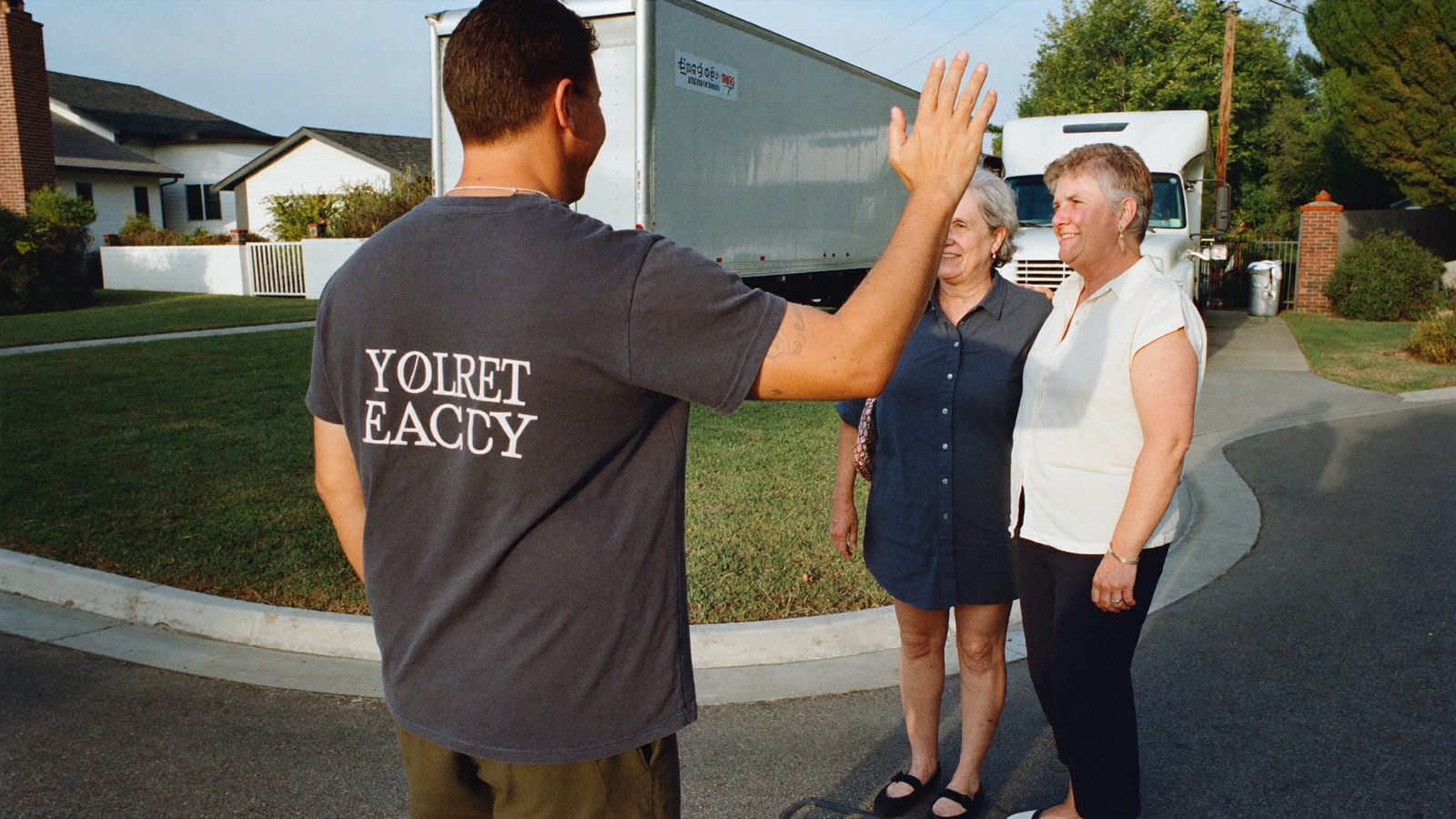
Here is the exact sequence my crews ran on every job. Finish the work. Do the final walkthrough. Take payment. Then say some version of: we are a small family business and reviews are how we compete with the big franchises, I am about to send you a text with a link, it takes about thirty seconds. Then, and this is the trigger, mark the job complete in the app before you drive away.
Marking the job complete fires the review request text within 30 to 60 seconds, while you are still visible in their driveway. The customer was just told the text is coming, so it feels personal instead of automated, even though it is completely automated. That handshake plus instant text combination is the whole trick. Either piece alone works half as well.
Set up the automated review request
The automation itself is simple: when a job's status changes to complete, send an SMS with the customer's first name and your Google review link. Any decent CRM can do it, and it is exactly what Autopilot's review funnel and automated texts were built for. A few setup details decide whether it actually works:
Register for A2P first. Carriers now require business texting to be registered before you can send custom SMS. You will need your business info, ideally an EIN, a website URL, and a real business structure like an LLC, and approval can take about a week. Do this before launch week, not during it.
Get the right review link. Google gives every profile an ask for reviews link. Grab it from your Google Business Profile, or if you run a service area business, paste your Maps share link into a review link generator. Then test it on your own phone. A review request that opens the wrong screen is worse than no request.
Personalize with a first name variable. A text that opens with the customer's name reads human. That only works if whoever answers your phone enters names cleanly, so make proper data entry part of the booking script.
Keep the message short and human. One or two sentences, the link, and a thank you. Corporate paragraphs get ignored.
I made a short walkthrough of building this exact automation: the one automation that gets you more 5-star reviews.
The follow-up sequence for the forgetters
Plenty of customers fully intend to leave a review, then dinner happens. The instant text catches the motivated ones. A follow-up sequence catches the forgetters, and it is the layer most companies never build.
Mine worked like this. When the job wraps, the crew tags the client, the client and not the job, with a review follow-up tag. That tag enrolls them in a sequence: wait a day, send a friendly nudge. Wait two more days, nudge again. Wait four more days, send a final text with their first name and the link. The moment the customer replies or the review shows up, the sequence stops. Nobody gets spammed.
The copy matters as much as the cadence. These texts should read like a human typed them: casual, grateful, with the small family business framing that reflects reality. The moment your follow-up sounds like a corporation, it performs like corporate mail.
Two more notes. Dedicated review tools like NiceJob charge around $99 a month for what I just described, which is a fine product but a silly expense when your CRM already includes it. And this two-layer setup, instant text plus follow-up sequence, is the system behind my video titled how to 5x your Google reviews automatically, because layering the sequence on top of the single text is what separates a trickle of reviews from a compounding pile.
More jobs, more reviews: the volume flywheel
Once the ask is automatic, the review count becomes a function of job count, and that changes how you think about marketing.
At my Ventura location, I pushed Google Ads hard, averaging around $300 a day and peaking near $500, which kept the truck at three to six jobs a day. When I opened Los Angeles, I was spending roughly $700 a day there and running about 200 jobs a month. Every one of those jobs asked for a review automatically. The ad budget was not just buying revenue. It was buying review velocity that made the profiles rank better, which produced cheaper organic jobs, which produced more reviews. That is the flywheel.
You do not need my budgets for the flywheel to spin. You need the ask wired to every job, and then whatever lead flow you have, from my junk removal leads playbook or anywhere else, compounds on both sides: money now, ranking later.
One operational note for multi-location owners: your automation needs to route each review request to the correct Google profile. When I ran multiple locations, the software matched the job's location to the right review link. Ventura jobs fed the Ventura profile, LA jobs fed LA. Get this wrong and one profile starves while the other eats.
What not to do (from someone who did it)
Full honesty: in the very early days, I bought some fake reviews. I will not pretend otherwise, because operators trade these tactics constantly and someone pretending to be pure is less useful than someone telling the truth. It was a dumb risk. Google has gotten aggressive about detecting fake review patterns, profiles get suspended over it, and the moment my real system started producing volume, the fakes became pointless as well as dangerous.
A few other traps worth naming:
- Do not pay customers for reviews. Incentivized reviews violate Google's policies and read fake anyway.
- Do not batch your asks. Fifteen reviews appearing the same afternoon after months of silence looks manufactured because it is.
- Do not review-bomb from your own network. A pile of reviews from accounts that never reviewed anything else is a pattern.
- Do not ignore what reviews tell you. If the same complaint shows up twice, that is an operations report, not bad luck.
There is also a quieter cost to fake reviews that nobody mentions: they do not sell. Real reviews name the crew member, the couch, the staircase, the price. That specificity is what convinces the next customer reading them. A page of generic five-star praise from empty accounts persuades nobody, so even when fakes slip past detection, you paid for something that does not do the one job reviews exist to do.
The legitimate system is genuinely easier than the shady one. That is the punchline. Asking every real customer at the moment of peak gratitude, automatically, outproduces every trick, with zero risk to the profile you are building your business on.
FAQ: how to get more Google reviews
How do you ask a customer for a Google review?
In person, at the end of the job, right after the final walkthrough and payment. Tell them a text with the link is coming, frame it honestly, small business, reviews are how we compete, then send that text within a minute. The in-person heads-up plus instant link is the highest-converting combination I have found.
Can I text customers a Google review link?
Yes, and texting massively outperforms email for service businesses. You will need A2P registration first, which requires your business details and roughly a week for approval, and you should use Google's official ask for reviews link for your profile. Keep the message short, personal, and send it while the job is fresh.
How many Google reviews do I need?
More than the competitors you want to outrank, and arriving steadily. A profile that adds reviews every week signals an active business far better than one that got fifty reviews in one month a year ago. Velocity and recency matter alongside the total, which is why the ask has to be automatic on every job.
Is it OK to offer discounts or payment for reviews?
No. Incentivized reviews violate Google's policies and put the profile you are building at risk. You do not need them: a well-timed ask sent to every real customer produces more reviews than incentives ever will, and those reviews mention real details that make them convincing.
Why are my customers not leaving reviews even when I ask?
Usually timing and friction. An ask at the end of the day or by email gives people time to forget, and making them search for your business adds steps. Send a direct link by text within a minute of finishing, use their first name, and follow up over the next week. The forgetters need the nudge, not a better speech.
Put your reviews on autopilot
Every job you finish this week is a review you either capture or lose forever. Autopilot plans start at $49 a month, with the review funnel and follow-up sequences on Full Throttle at $149. Start a free trial or check pricing, and compare that complete toolkit with separate review subscriptions.